

I just got back from Altlanta. I have a new job and a new apartment and I’m tired from the drive.
I’ll tell you some amusing bits about my first two days of work tomorrow.
|
I just got back from Altlanta. I have a new job and a new apartment and I’m tired from the drive. I’ll tell you some amusing bits about my first two days of work tomorrow. Today is one of the most boring days I can remember. I have been sitting at home all day waiting for one phone call. I’ve received 4 phone calls, which is 4 more than I usually get, but none is the one I’m waiting on. I’m just wasting time, waiting. Waiting alone is not a good thing. The house is empty. I’ve drunk so much coffee I’m sort of fidgety. My dog is infinitely patient sitting near the gas logs napping, which makes my impatience all the more intolerable. I went to bed at 12:30 and stayed in bed till about 12, again waiting. You have weird dreams when you sleep that long. The 4 phone calls this morning all woke me up, which is why I remember the dreams. I can’t return those calls otherwise I’d tie up the phone. Of course the minute I get on the phone, they would be trying to call to offer me a job. I’ve been looking for a job a long time. My dad told me last night he was proud I have been so patient in looking for the right job. “A lesser man would’ve settled for something 6 months ago and been unhappy with it,” he said. I say a better man would’ve found a good job six months ago, and as far as being happy with it: I’ve never proven I can be happy at a job; what makes me think I can do it now? Actually, I was happy at camp….although that lasted only 10 weeks. Actually, this time I have a good feeling about my potential job satisfaction. Why? I’ve learned a great deal about self-control over the past 5 years. The best and most sustainable way to achieve some sort satisfaction with your life is to decide that it will be so. This is exceedingly difficult to do, and requires a degree of mastery of self that is near impossible. How well can you police bad thoughts and remove yourself from negative environments when you often don’t know if the thoughts and environments are negative until after you’ve experienced them? By then it’s too late. I think, really, the discussion is moot. I’ve said I will get a job, for reasons explained in earlier posts. This is both a decision and a realization that, without working, food clothing and shelter can become a challenge. Our preoccupation with happiness is a seldom recognized affliction of modern affluence. How wonderful is it to be able to worry over the capriciousness of our wandering spirit? In the past no one cared whether or not you were happy, least of all the unhappy. A hungry stomach is indifferent to the mental state of its vessel. Before civilization I doubt we even had a dim grasp on the many shades of happiness. It is only with the dawn of excess a few thousand years ago that people were afforded the extended idleness needed to consider whether or not they enjoyed existing. As we got better and better at making stuff we created enough surplus for ever larger numbers of us to be idle to consider our inner state. We went from a few Greek playwrights to, thousands of years later, entire movements of literary thinkers lounging around Paris essentially complaining that life was meaningless because they no longer had to scrounge for food, clothing and shelter. Only the well fed can afford to be depressed. This brings us to today, where it is assumed that happiness is a birthright. It is no coincidence that unhappiness has increased as a result. As I have found through experience, thinking you must always be happy can itself become a source of unhappiness when you find it is impossible to attain, thus believing that it is some defect in yourself or unfairness of the world that is impeding your eternal inner peace. When modern life, with all its complexities, is seen in these terms, we should be grateful even to have the opportunity to consider whether or not we think we are happy. Before that Buddha stated it quite simply: All Life Is Suffering. And in those days, it likely was. Tuesday I’m going to Clemson to speak with the head of the Economics department. I’d been trying to arrange a meeting with anyone who’d agree since December. On January 29 I wrote an email to Robert Tollison, who I was told is the most senior and respected economist on staff. Here is his reply: “I am sorry but I am terribly overcommitted at the moment. If you could wait until June, I would be happy to meet with you. June?? He doesn’t have an opening on his calender until June? If I am ever that busy please shoot me. In his defense, at least he didn’t say no. In fact, I am planning to write him back at the end of May to set up a time…..just for kicks. I can’t figure out why it takes so long to do things. Maybe one day I’ll get it. I remember reading advice about how long to wait to follow up with a recruiter or potential employer. Most sources suggest a week or 2. Most of the time it is a month or more before I hear back from them. Sometimes they call and it has been so long since I originally applied I don’t even remember who they are or what the job is. I just end up sounding like an idiot. I told Bobby McCormick I was researching an article called “FAQ about the Economy”. He agreed to meet with me. My next post will have to be called “FAQ about the Economy” so that, technically, I will be researching such an article and not make myself a liar. I really don’t know what I expect him to say. I’ve been collecting these questions for a long time, and many of them I’ve answered myself. Still, it should be interesting. This is funny: When I first started looking for jobs over a year and a half ago I did a little reading: “What Color Is Your Parachute?”, “Crossing The Unknown Sea”, and endless articles with advice on landing a job. What I noticed is that, while jobs themselves were scarce, articles and books about jobs were plentiful. Imagine that? So I did some research and wrote a very good and informative piece on how to get a job. And just as I suspected, I was far better at writing about it than acually doing it. I never got the article published because writing is a very insular industry and major newspapers are generally unionized. This means that freelance submissions are not permitted. I asked Woody White from the Greenville News about that very issue when I called him to gauge interest in my article. He promised to “take a look at it”. This meant that I would take the time to write the piece and he would take the time to tell me he couldn’t publish it. Well….we see who gets the last laugh!! It seems I am now an expert in job hunting (although I am still unemployed). Content from my article, published nowhere but on this site, is quoted alongside other reputable sources at BeyondTheResume.com as providing “professional” insight on the art of job-hunting. Here is the link: http://www.beyondtheresume.com/testimonials.aspx. Mine is the third quote. Anybody else need any expert advice?? Its been a while since I’ve made a post. I haven’t been doing much, nor I suppose have I been thinking much. I look for jobs that I’m not qualified for, drink lots of coffee, play basketball, drink heavily on occasion, and see my girlfriend. Oh yeah, and I sit in front of this computer alot too. I’m reading three books right now. “Topgrading” is a business book about the challenge of recruiting and keeping talented employees. Its ok, sort of strikes me as a long advertisement for the author’s consulting services. “Inside a US Embassy” is a behind the scenes look at life in the Foreign Service. I’m taking the Foreign Service exam in April and thought that before spending 3 mosquito-infested years as the ambassador to Upper Volta I’d do a little research on the job. “A Day in the Life of Ivan Denisovich” is about the Siberian work camps under Stalin. It paints a pretty grim picture. I don’t understand why the book is so famous. It is fair at best. I just finished “The Progress Paradox”. It is the best non-fiction book I’ve read in recent memory. I loved it. It outlines the rise of the American economy against the fall of American well-being. It is extremely interesting, both psychologically and economically. Other than that, nothing. I would like to make a trip to visit some friends, but I don’t have the money. If I had a job, I’d have the money, but not the time. Oh well. I think I’ll go to bed. Dear People, I think this is the first entry I’ve ever written that is a direct response to someone else’s question. It is also something I’m sure others have considered. BC Rogers made me think about it again the other day in an email and I feel I owe him and some others an explanation. If I have such an issue with the work/consume attitude, do not share the American obsession with productivity, think we’re often being scammed and told half truths by our government and find most people to be blindly unquestioning of the status of their lives….then why don’t I pack up and fucking leave??? I’ve done it before and obviously miss traveling. It is almost as if I am whining and lack the nerve to go. Everyone hates a whiner….even me. Why am I still here? I have a gut feeling as to why I haven’t left, but I’m not sure if I understand it well enough to say it in words, but here goes: Yes, my past does haunt me. Yes, I miss travel. But that does not mean I want to or should return to it. When soldiers come home from war they have a hard time re-acclimating to regular life. This is not soley because they are scarred from killing foreigners. During war life is very intense. Everything is meaningful. Things happen in a flash and the stakes are high. You live forever wrapped in the moment because it is so important. Regular life in the US pales in comparison. It is simply hard to get motivated to trudge through another day of work, or worry about dinner parties or office politics when you think back on what your life was once like….no matter that it was good or bad….just that it was once intense and meaningful. How can a daily routine ever compete with life at high volume?? I know I am not a soldier. I know the analogy is not completely valid, but it is real nonetheless. Reality TV stars complain about the letdown after the cameras stop rolling. Actors and performers speak of the rush of being on stage. After their careers end professional athletes can sink into depressions that last for years. All of them speak of missing the game. They miss that feeling. Travel is like that. Nearly all travelers experience withdrawl after they go back home. Re-acclimation is extremely difficult. Depression is very common (something I have thankfully avoided). I know this not from any scientific studies, but from conversations with real people. You see, travel is like a drug…actually, no. Travel is a drug. You become addicted to the next place even when the next place is no longer the source of pleasure it once was, but merely a way to alleviate the anxiety of sitting still. The estrangement from your former life can only be escaped by continually starting a new one. Like a drug, travel resembles life, only more intense. It is the source of your pleasure and the absence of it is the root of your pain. The more you travel the less normal life offers you, which in turn further distances you from your previous life, which makes you more alienated, which can only be soothed by more travel. Like a drug, it escalates. You must always do more of it, to more remote places, for longer periods of time, with ever higher stakes to experience the wonder you once felt just drinking a bottle of cheap red wine overlooking the Seine watching Paris at night. Like a drug, you long for it. You tend to forget the lonliness and remember the endless string of new and interesting people. You forget the shitty beds and restless sleep in favor of waking to a croissant and expresso looking forward to discovering a new city. You tend to forget being lost and hungry wandering around the new city and remember when some local takes pity on you and shows you a great dive restaurant then takes you out for the evening at a club that used to be a castle dungeon. You forget getting robbed of everything you have and sitting misreably at a dirty police station trying to file a police report in Spanish and remember flying to Mallorca to ride scooters with an old friend. Like cocaine addicts, you remember the rush of the hit, but forget the 3 days without sleep. And finally, like a drug there are withdrawls. I experience those withdrawls and long for it at times, but the cure is not to take more of the drug. Although travel is a drug, that is not the only reason I choose not to leave. After all, drugs destory your life and wreck you body. Travel does neither of those. If I chose to remain an addict so to speak, life would go on. I don’t think I would require an intervention. After all, we all chase feelings. We are all addicts to something. The decision to stay is about a choice: Seize the Day or Seize your Life. They are not one and the same. Travel is so immediate. It is a lifestyle for the young and unattached. It is romantic and lonely. But life can’t always be about living in the moment. To forever seize the day is a false grail. Some goals necessarily take longer to achieve, a better commitment. Is life just a series of unrelated experiences to be gobbled up or do you want your life to be about something, to tell a meaningful story?? Shall I die saying I ate life till I burst, sailed the seas and trekked the deserts, that I loved deeper and lost more on distant and foreign shores than others even imagine, or shall I say I helped my neighbors become better people, contributed what I could to the human condition through my work, loved my wife and family all I was able, and left my children with an opportunity to surpass what I was even able to dream?? That is the choice. It is not a rhetorical question. It is not as if there is no reward for being the moth to life’s flame. There is certainly value in coveting all you can of life. But seize the day and you remain forever a student of life, never its master. Understanding why that is true is a very hard lesson. I have largely lived the first option. The romaniticism it holds for most people is understandable, but the bullfighter dies alone. That is what they don’t see. I choose the second option; not necessarily because it is better, though it may be, but because I have not yet tasted its secrets. I believe we can do better, but building something better for tomorrow isn’t a result of living life as if today is your last. Of course I really want it all. I want both tomorrow and today. And in a sense that is what I am getting. I have eaten life for long enough. It is now time to grow something. “When I was a child, I spoke as a child, I understood as a child, I thought as a child; but when I became a man, I put away childish things.” 1 Corinthians 13.11 Not to say I will never travel again. I have never believed that one cannot eat their cake and have it too 😉 Lost in Translation is a very good movie, but I do not see the appeal for non-travelers. It tells so well what words alone fail to about the subtleties of life in the Orient. But if you’ve never been a Westerner living in the East, I fail to see the appeal. People sometimes ask me: What do you do when you travel?? In the movie Scarlett Johanssen often walks around aimlessly, stumbling from one disconnected event to the next, always looking around, slight puzzled, slightly overwhelmed. That is what you do when you travel: You wander around puzzled and overwhelmed just sort of waiting for something to happen. And it often does. In the first scene of the movie there is an off-handed comment by a Japanese man getting on the elevater. He says to Bill Murray, “Please to welcome you to Japan.” It’s little things like that on eternal repeat that turns life abroad into a carnival. The movie captures so much of the irreality of travel, the circus atmosphere. So often while living in Taiwan I caught myself thinking: “Is this for real? People aren’t like this. The game is up. I know the cameras are hidden somewhere.” But they never are. And so very slowly the ridiculous bleeds into your daily life until it becomes normal….and at that point, when abnormal becomes normal, you’ve lost your grip on reality. There are the lights of the city, sensory overload. And the people, billions of them, all short with black hair. And the stares you get, like you’re being asked one long unanswerable question. And the odd requests: “Please take a picture with me…” as if I were famous, or “Can I touch your face?” What is my reply to that? Soon you wonder when people don’t want to take pictures with you; you expect little kids to pull at the hair on your arms. And the conversations with other Whiteys….there is so much to talk about, the country, the people, why you came, the locals, the beer, the women….but no one ever asks the question we usually ask first: “So, what do you do?” Why not? Well, if you’ve felt the need to go to the other side of the planet chances are you don’t do anything. If you did something you’d be doing it back home and not seeking your proverbial fortune in the Orient. In the past Americans went West in search of something new. The Orient attracts those who felt the West just wasn’t quite far enough away. I love those odd moments, like when you’re at some buddhist shrine and monks are chanting and praying, the incense is burning and some old woman shuffles by picking her nose and trips over a stray cat scrounging for the food. In life there are no second takes. Your preconceptions are nearly always less than the reality. And through all that you catch those brief moments when you turn the corner and the sunset breaks through the smog and you hear birds chirp in the park over the din of scooter noise….and it all seems amazing and worthwhile…but still unreal. The rice loving vertically challenged locals are trumped only by the foreigners, your bretheren. To be so far away from home one must rightly ask: “What the hell are you doing here?” If you are in Europe perhaps the desire is to become more worldy or cosmopolitan, but as a Westerner in the East you are not running towards, you are running away. The question could be rephrased: “What was so bad at home that you felt you needed to run all the way around the world to escape?” And those are the people you meet, the ones who are your buffer against the endless bowls of rice, days of rain and russian roulette traffic jams. And so it becomes given that you are lost…if you were not lost before you came, you certainly have forgotten the reasons….adrift in a sea of karaoke bars and neon lights, a country-wide circle jerk of neurotic, worldy twenty-somethings desperate for something to hold on to. There are no more anchors. Reality shifts below your feet. Everything is up for reexamination. There was a day in Greece 9 years ago I remember I wanted to call my mom to make sure everything was still real. So there you are alone, making your way down the street by the polluted river watching the rats scamper along the docks. You stop by your favorite street vendor to order some yummy, but unidentified, treat cooked in a rusted wok from a tired old man with 3 long hairs growing out the mole on his face, handing over some monopoly money currency and wondering what the fuck you’re doing on the other side of the planet. And so where do you go? The locals are pulling the rug out from under everything you once considered normal, your fellow Westerners are all fleeing the fallout of their former lives and alone you simply turn inward and feed on yourself, running around inside your head like a mouse on a treadwheel locked inside in a never ending b-rated kung fu flick. That is life in the East. That is how one gets Lost in Translation. Here is an insight. The movie does a terrific job of illustrating one of the great and secret draws of travel: Escape. Not necessarily escape from something or somewhere, but mostly an escape from yourself. Escape from yourself….we do it through TV and alcohol, through sex and work, through religion…even gardening or sewing. Its like a temporary reprive from the weight of life. Don’t you ever get tired of being you? Are you really that great that you require your undivided attention every second of your entire life?? Travel is an extended vacation from that life. You cover more ground but skim across the top, a spectator, untouchable….you watch yourself like a movie, star in a few scenes and then dip out and show up a week later in Malaysia. Travel is not your life. Travel is the life you want, the person you think you are. You are now the star of your life as a movie: exotic locales, lonely women with foreign accents, white beaches, cheap liquor and an overall sense of lawlessness. Don’t like the script? You’ll have a chance to rewrite it tomorrow in another equally exotic locale with cheaper liquor, even farther away….. How far is far enough?? How many times do you escape before the escape itself becomes your new life….from which you would presumably need to escape again?? Can you take a vacation from your vacation from yourself? Am I really so self-loathing that I need such a vacation?? I never thought of myself as very self-loathing at all. My past is a weight I cannot put down. Travel is the ghost that haunts my head. Anyway….it was a good flick and reminds me why I don’t often do stuff that reminds me of travel. This was once the view from my porch. I looked at the Cordillera from this very same spot a million times while I was in Chile and it never offered me the same view twice. 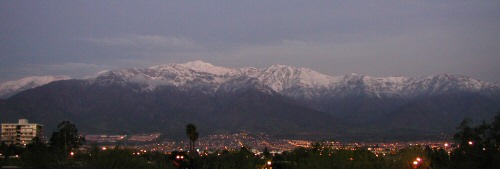 At dawn the sky is fire. The sun rises up behind the Cordillera and if you’re awake to see it, which I rarely was, it is almost blinding….like some sort of fire and brimstone from an old Bible flic. For the record, it didn’t always look like that. This day was exceptional. 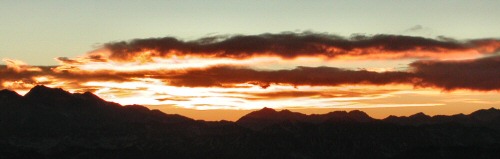 In the morning it is crisp and naked. This was taken on my very first morning of work at 6am on the way to the bus stop. It was the middle of winter, early July. I was so nervous and excited. I came to dread that job in the end, but the view never ceased to amaze me. 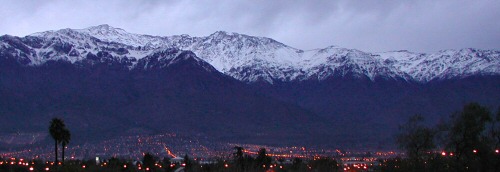 In the afternoon the Cordillera plays hide and seek with the clouds and sun. This was in the summer, right before I left for Patagonia. The weather was perfect that day, a bright sun and warm wind. I got really close with my roommate Christian, but we’ve hardly spoken since I left. He constantly had to remind the Chileans that he was from Austria, not Australia…which made me laugh. 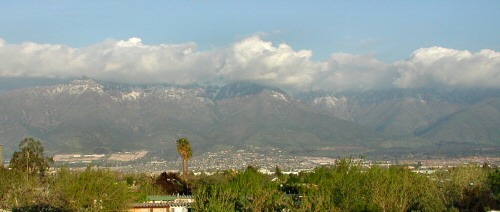 In the evening the Cordillera is a theatre for the sunset. I was by myself this evening, coming home from work. Santiago sits in a valley with the Andes acting as a cup, keeping in the pollution. The Andes are east of Santiago so the sun actually sets opposite the mountains, not over them, but often the sky was so orange there was a reflection off the snow and the pollution diffused the light, making the whole sky brillant. 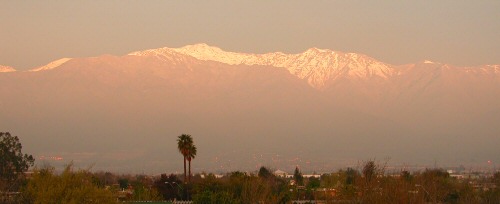 I remember one evening in Thailand throwing frisbee on the beach. The sun set purple and red over the white beaches and there was a lightning storm in the distance. It was all going on at the same time: lightning and frisbees and sunsets, laughing and drinking and banana pancakes and this little boy juggling fire. Ever heard of the Green Flash? I haven’t either. The crew of the Jennifer kept telling me that on a very clear evening as the sun sets, right after it sinks below the horizon you can very briefly see the fabled “green flash”. They always gave me the binoculars and recounted tales of the first time they saw the great “green flash”. I think they fucking made it up. I never saw it. Sailors tell stories anyway. Anyway, I never took the Andes for granted. I always figured I’d get used to it, but I didn’t. And if you take a look at the pictures, they are all taken from the same place on my porch. Notice the two lone palm trees? People ask about my life. They wonder about my travels. I cannot answer those questions but to say that I have seen the seasons dance on the Cordillera and I am not the same for it. My conversation with William Greider went well. We spoke at length about my favorite topics. I am sorry to say I did not learn a great deal though, not through any fault of his, but because our views were so similar it was almost like listening to myself, albeit perhaps more eloquently. Mr. Greider wrote a book I read recently called The Soul of Capitalism. It contains some commentary about the inhuman aspects of capitalism but mainly focuses on stories about people, businesses and communities that are finding ways within the current system to make capitalism work for us, instead of us always working for it. It is an inspiring book, just to know there are people out there who still believe there is more to business than making a buck…and are actually doing something about it. Our conversation centered around two questions that have been bugging me of late: 1) Are we choosing all this?? Are we choosing shallow lives based on consumerism? Are we choosing work over family and friends? Why do we continue to believe in the American Dream when the reality is that we work ever longer hours in households that now require two wage earners to maintain? Is that really an advancement in quality of life? 2) Does the free market work? This is a more philosophical, academic question, but it does have important implications. It tells us where we should look if we want to see a change, either to the market or the government depending on whether you think the market works. It also touches on a more fundamental question that I think we should be asking: What is an economy for? So are we choosing all this? There are two real options here: 1) Yes we are. If this is the case then it doesn’t say much about human nature. Every piece of information I gather points to the fact that people would like to work less, get in shape, spend more time with family, feel less stressed, and take more vacation. The reality is they are working more, getting fatter, spending less time with loved ones, feeling more stressed and taking no vacation at all. If we are indeed willingly doing one while saying we would like the other….then that makes us either liars and hypocrites or lacking the backbone to step up and demand a change. The flip side I suppose is that we would like life to reward our more human side a little more but reality demands us be slaves to the economy. This is a possibility. After all, no one ever promised life would be a bed of roses. Better to be a slave to the economy that to be a slave to land you farm (which could starve you to death in a bad year) or worse yet to be an actual slave. In the past I would have bought this argument. Life has been a crap shoot for most of human history. But that is no longer the case. We need not work ourselves to death or really even work that hard at all. The US GDP is over 10 trillion dollars. That is about twice as large as the next biggest economy (China) and three times as large as the third (Japan). GDP per person is $36,000 a year. Only Luxembourg ranks ahead of us. All the top six (except for us) are small countries that are either banking capitals or tax havens. We have so much fucking money it is ridiculous. In 2001, Americans spent 25 billion dolllars on recreational watercraft. That is more than the GDP of North Korea. The average household income is about $70,000. Worldwatch reports that worldwide annual expenditures for cosmetics total U.S. $18 billion; the estimate for annual expenditures required to eliminate hunger and malnutrition is $19 billion. Expenditures on pet food in the United States and Europe total $17 billion a year; the estimated cost of immunizing every child, providing clean drinking water for all, and achieving universal literacy is $16.3 billion. During that same period the number of Americans suffering from uni-polar depression has increased 10 fold. The number of people reporting themselves “very happy” decreased from 7.5 to 6 percent. So, money can’t buy happiness. We all knew that, but I’ll tell you what it can buy: Depression. Here is the greatest economic paradox of our time: With all our wealth, we are still poor. After a century and a half of technology advancements and time-saving devices, we work harder than ever. Poverty is still with us. 22% of US children live below the poverty line. In Sweden that number is 2.6%. Reductions in the rate of unemployment have been intermittent and temporary. The U.S. is No. 1 in the world in healthcare spending both per capita and in absolute terms, but the only major industrialized nation not to provide some form of universal coverage. More than 41 million Americans have no health insurance of any kind, public or private. One in four people with household incomes less than $25,000 is uninsured. So, to sum up: There is no scarcity in the US. We are rich beyond the wildest dreams of 99.9% of people who have ever existed. We need not work at the current breakneck pace. It simply isn’t necessary. This leads me to option 2: 2) No we are not choosing this. I believe this is true, not because I wish to implicate the rich in some sort of conspiracy, but because I refuse to believe people are lying hypocrites or submissive doormats. There are a million small reasons why not all options are available and the weight of all those adds up to tremendous momentum to maintain the status quo. This question also touches on my next topic: 2) Does the free market work? Is our current and lasting inability to address income inequality, health care, poverty, and work hours the result of previous, probably well-meant, government intervention in the market, or….would affairs be even worse if the government had not stepped in? Can the free market address all our problems? Separation of church and state proved invaluable to the quality of life of the average person. Should we also have a separation of economy and state? I will answer this question in my next post…. And then in my next, next post I will say some positive words about the economy. All is not so gloomy and there is much to be thankful for. I responsed to Josh’s comment about my post on January 9 here. Some time this weekend I’ll write about the conversation I had with William Greider today. |
Powered by WordPress, Mandigo theme by tom.
 Entries (RSS)
and Comments (RSS).
Entries (RSS)
and Comments (RSS).
