Author Archive

I have some things to share with the 7 or so people who might read my website:

Why I am apolitical:

I’ve always stated that I am apolitical, neither democrat, nor republican, nor centrist, nor libertarian.  But I have strong ideas about politics and the role government can have in our lives…very strong ideas.

So as I watch the bailout of the financial system and the endless debate on healthcare reform everyone agrees in theory needs to happen…..I ask myself:  Why am I  not more political?  Here is why: because there is no substantive difference between the democrats and republicans.

We think of them at opposite ends of the ideological spectrum, but they are not.  They argue loudly about small difference they make seem big while rarely addressing anything substantive.

I’ll use the example of the financial system bailout:  Both the republicans and democrats wanted to bailout the financial sector; they just argued about the amount (both amounts being very large) and how to spend the money.  The Republicans started the bailout and then the Democrats inherited it, and continued the same basic policy.  Neither party addressed why it happened in the first place; no one (except maybe Ron Paul) wanted to discuss the structural issues of a monetary system based on debt and a fiat money controlled by unelected officials making decisions behind closed doors (the Fed).  Neither party has addressed the “too big to fail” issue (not only that, but the big financial companies have used the bailout money to buy up the smaller companies that failed during the crisis; they’ve actually become bigger).

Here is another example:  9/11.  Both parties wanted retribution.  No party was brave enough to say:  ” 2993 died today in a terrorist attack.  6,744 people die a day on average everyday, so to put that in perspective, America is not under attack.  This was high profile and a great tragedy, but to upend our way of life, to start long costly (very costly) wars on foreign soil with unclear means of success in which more men and women will certainly die…..to restrict and lose, in the name of increased security, the very freedoms and civil liberties we would claim to go to war to protect…..this is not acceptable.  If this is our response to terrorism, then certainly we have already lost.”

This brings me to my next point.

Why Republicans want healthcare reform to fail:

I do not think the Republican’s opposition to healthcare reform is 100% genuine and in the interest of their constituents (even if you include the healthcare companies as their constituents). Republicans want healthcare reform to fail because if the Democrats pass the reform the people want, the Republicans may not see the inside of the White House or a majority in Congress for a generation.

The point, is that neither party has a genuine interest in doing what is best for us….they have an interest in getting re-elected.  They pass laws based on that and little else.  Democracy works because the two can definitely overlap; if you pass laws people want, you get re-elected…..but their are other ways to go about it as well:  money can also get you re-elected (so pander to companies); being less-bad than the alternative can also get you re-elected (just bash the other party and say great things about yourself).  In short, there are alternative ways to get re-elected.

This brings me to my next point.

Why I want to go back to school:

I’ve been kicking around the idea of going back to school to get a PhD in Economics.  In the long term, its a good life to be a college professor, and in the short term it would allow me to follow these ideas to their natural conclusion.

Incentives.

People are neither good nor bad; they act, en masse, according to the situation in which they find themselves.  Modify the incentives and you modify behavior.

I would like to study some form of behavioral economics that would allow me to construct a system of incentives to help people avoid all these situations.

The economic system in which we operate works together with government/law to create the set of incentives that control our lives.  I would like to draw lines in the sand, to establish some facts and some subtlety:

The free-market can fail to reach optimal outcomes. We must accept that these textbook perfect market conditions don’t exist in the real world, and even if they did they would still produce monopolies, corruption, inequality, price fixing, etc.

Economy doesn’t exist w/o government….therefore government has a role to play…not as a spender of money, but as a regulator, a system-maker.  We need to accept that the invisible hand of capitalism produces anxiety, inequality and pits us all against ourselves.  This produces crime, mistrust and ill-health.  We don’t want to live in a country like that.

GDP is a horrible measure; lets replace it:  It promotes over-consumption, doesn’t differentiate between types of spending, and you can’t subtract from it.  Here is an example:  The US has the largest economy in the world with a GDP of 12 trillion (per year).  I can turn the tiny nation of Uruguay (or any country for that matter) into the largest economy in the world:  Let them borrow 13 trillion dollars from someone and spend it all on rat poison next year.  They will be horribly in debt and have a country full of rat poison…..but they will have a 13 trillion dollar GDP.  You might be thinking “that’s not how it works, surely!?!?!”…..but oddly enough, it is.

Monetary policy is the basis of our society, because money controls/influences most of our actions.  Fiat money created by debt is the structural issue that has caused our current crisis, and yet few seem to understand that (so no one addresses it).  Money systems fail (and empires fail with them).  To create a lasting society, you have to create a lasting money.  Our current system is unsustainable; it allows the government to confiscate our wealth through inflation.  Taxes are cheap in comparison.

I would like to clarify these ideas, to write my own Das Kapital; furthermore to elaborate it using agent-based computer modeling so that it isn’t all theory, you could potentially model changes to law/monetary policy to see the potential effect.  It would be akin to what weather forecasters use; imprecise, but better than nothing.

What do you think?  Quit my job and go back to school or continue as is?

Tags: ,

Comments 2 Comments »

Obi Wan said he felt a great disturbance in the force when Alderaan was destroyed by the Death Star.  He was right; however, he was also a movie character and a Jedi bad-ass.  Real people can’t sense stuff like that, but they do occasionally get a feeling they haven’t felt in years, like Vader did when Obi Wan was on the Death Star.

I have wondered often what makes someone old; why do people grow up?  They obviously age physically, but what happens that makes them think about things as an adult.  There are advantages to being an adult, and some to being an eternal adolescent as well.

Today I was transported backwards about 15 years for a few minutes.

I sat there for a second and went…..”wow, so this is what it feels like to be young”.  Young is full of anxiety and anticipation.  It is uncertain.

Adulthood is more self-assured, less explosive, wiser.  I think wisdom is often just the realization that everything is dependent on time; the answer today is not always the answer tomorrow….and yet we must still have answers.

Adulthood is repetitive.  Youth hasn’t had time to be yet.

Youth creates your pains.  Adulthood is learning to live with them.

Youth dreams and dreams are quick.  Adults do things, and that takes a lot longer.

Youth is subsidized by adults.  Youth is not-sustainable for this reason.  Adults realize that nothing gets done unless they do it.  Youths are mistaken in the amount of effort it takes to make life happen.

Youth is beautiful and beauty is very powerful.  Adulthood realizes beauty is persuasive, but not always useful.

Youth burns.  Adults realize nothing burns completely.  Be careful what you burn.

Youth lives in a world of ideas, since they have little yet of life to fill their heads.  Adults live in a more concrete world, as reality tends to swamp idealism as the years stack up.

Adulthood is overly cautious.  Youth is rash as it doesn’t yet realize how fragile and precious life is.

____________________________________

The point is that today I felt young again for a second as something old was made current and I was transported backwards in time.  What an odd feeling…like it was happening to another person.

My distant past (before Atlanta and grad school, those years when I traveled, and before)……is so far removed from my present life that I remember it like a movie.  That person I was no longer exists.  But he did for a few minutes today.

I can’t say much was better about the former Elliott, except that he was younger, better looking, more full of himself, and had more hair….I guess not everything is better now 😉

Comments No Comments »

Hard work always wins.

Comments No Comments »

I pride myself for being a hack, weekend economist.  I admit it isn’t going to make me rich, but it is interesting.

It is easy, at first pass, to answer the “why did we bailout the financial sector” question.  The answer is because they are rich and have powerful lobbyists, and there is intuitively some truth to the claim that without a finance sector to grease the wheels of the economy, that it would grind to a halt.  So whether or not the companies are to blame for their own mess; we need them, so we have to save them….I guess.

But why do we need them?  Why, if too much credit got us into this mess in the first place, was there a deafening cry from Washington to get credit flowing again.  How could the disease be the cure? (BTW:  that was the premise of the bailout:  We want this bailout money to go towards lending.  Lending had stopped because risk couldn’t be accurately gauged.)

The question then becomes, “Why do we need lending?”  What is so important about the ability to keep credit flowing that we literally cannot do without it, even for a little bit, while the financial sector shakes out and healthier companies (those without exposure to bad debt) take the place place of the old financial sector?  How long could that take?  A year?

Why the cry from Washington of “We must act NOW,” as in RIGHT now.  They passed the TARP bill almost immediately with no rules attached, and started handing out money willy-nilly….compare that with healthcare: In healthcare there is a near endless debate over a change everyone agrees in theory needs to happen (overhaul of costly system) and for which there is a moral imperative (richest country in the world with 47 million uninsured citizens)….then TARP:  No debate, no moral imperative, very costly, no oversight/enforcement, benefits only a few.  How did that happen?

I think I figured it out, and I figured out a few other things in the process:

Money is debt.  That is why we need debt.  Without it there is no money….literally.  95% of all money in circulation is debt.  If all that debt were paid off……..there would be almost no money, and thus no economy.

The government doesn’t create money in our monetary system.  The banks do. They do so through loans.  To simply a bit, when you take out a loan, that is new money.  It isn’t taken from another person’s deposit and given to you.  The money didn’t exist before.  When the bank credits your account for the amount of the loan the money comes from nowhere…it is created with a digital keystroke. Money can be thought of as a series of IOUs (debt), which, if they are all paid back….equals zero.

(This answers the question as to why banks are so profitable.  They don’t actually need any money.  They give you money they just created from thin air, and then you have to put up the house/car/etc for collateral (which you may end up losing to them) and pay them back interest.  Interest on what? They didn’t risk anything…..they didn’t actually put up any money on their side.  They don’t stand to lose much, since they can buy insurance on loan failures and they get the collateral if you don’t pay.)

So back to the bailout:  Why must the debt keep flowing?  Why MUST banks lend or the economy comes to a screeching halt?

Two reasons:

1) Loans are always being paid back (which destroys money; money lent is money created, money paid back to the banks is money destroyed), so for the money supply to continue to increase, there must always be more loans going out than there are payments coming back in.  If loans don’t go out, the money supply contracts and deflation occurs. Deflation is a hard loop to get out of, and is definitely bad for the economy.

2) If I borrow a dollar from you and then you borrow a dollar from me and we later pay each other back, then all is good.  But what if we decide to charge interest (which banks do)?  There is only two dollars in our economy…the money simply doesn’t exist.  One of us has to go bankrupt because we won’t be able to pay.  The only way to pay is to borrow money from a third party (or borrow more your original lender).  This is how our economy works.  You always borrow the principal of the loan, but you must pay back principal plus interest.  Where does the interest come from? We borrow it (because that is pretty much the only way to create money).  Individuals may be debt free; that is true…but the system as a whole must always borrow an escalating amount because the system must always pay back principal plus interest on the original principal or people (the system) goes bankrupt. That is what we are seeing now.

And that is why lending must happen.  That is why we saved the financial sector.  Debt is money.  Without the debt/credit/banks….there is no money and no economy.

I think if everyone were a little more educated on how our money system works this would be a better country to live in.  All that shit they do in Washington is just smokescreens and old, self important white men thinking they know something.

Permit me to issue and control the money of the nation and I care not who makes its laws.” — Mayer Amsched Rothchild

If the American people ever allow the banks to control issuance of their currency, first by inflation and then by deflation, the banks and corporations that grow up around them will deprive the people of all property until their children will wake up homeless on the continent their fathers occupied.” — Thomas Jefferson

Tags: ,

Comments No Comments »

Sometimes I think so.  It can’t be true though.  IQs are going up (Flynn Effect).  I do think people are uniformed, but certainly people have always been uninformed.  With the Internet providing more information that we can ever possibly wade though, and college attendance at an all time high, there is no excuse for being uniformed…moreso I believe that since all that information wasn’t even available in the past that people are actually more informed now that ever.

So…people are smarter and more informed than ever.  Why are they such idiots?

Hmm….well, maybe they are informed, but informed of the wrong information (which makes them seem dumb)?  That is a hard hypothesis for me to get my head around since if I were also misinformed then me commenting on other people’s misinformedness would be making the problem worse.

I know people are misinformed (including myself); however I know that; so not being an idiot might simply be knowing that you don’t know.  A healthy skepticism (even of yourself) is not exactly inspiring, but it is a useful bullshit detector.

I think people are apathetic.  They may be relatively well informed and intelligent; they just don’t give a fuck.  Republicans or Democrats?  Why does it matter since they both pander, lie, and misrepresent?  Fox or MSNBC?  Doesn’t matter.  They both spin. 

You just give up maybe.  After all, you still have to get out of bed in the morning…focus on what you can control.

Anyway, my bullshit detector is stuck permanently on, so here you go:

Health Care:

Lots of debate these days about this. 

Spin: “National Health Insurance will ration my care.  There will be long lines.  I’ll die on a government list waiting for my surgery.” 

Fact:  Yes.  Your health care will be rationed.  HOWEVER, IT IS ALREADY RATIONED….by money.  The rationing goes like this:  If you have money, you get care.  If you don’t have money, you don’t die on a government list waiting for treatment, you die at home unable to even see a doctor.

Why must health care be rationed?  You can’t provide unlimited use of something and expect that it won’t eventually consume all resources.  Everything is rationed in some way; most things are rationed by money (others by law, etc).

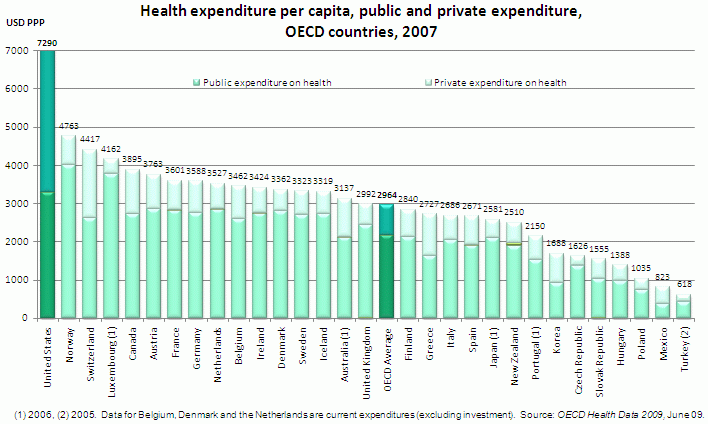
So does that mean you will not receive some services that you want, or if you do, then you may have to wait?  Yes.  That is what it means; however, bear in mind that this is ALREADY the case.  Public health care just changes the means of rationing.  Besides, as shown below with life expectancy, rationing doesn’t seem to change health outcomes.

Why not let money continue to ration?  I guess that is fine, except that our current course is unsustainable (costs too much), and what happens when you don’t have the money/lose your insurance (Medical bills prompt more than 60 percent of U.S. bankruptcies.)?  Are you willing to risk that?  US insurance is tied to jobs, and people change jobs a lot more than they used to…you will get caught in between at some point and find out that private health insurance is unaffordable (the same private insurance industry that says there is no need for reform). 

Spin:  We have the best health care in the world.

Fact:  People with money have the best health care money can buy.   On average we do not have the best health care in the world. 

In fact, we are 50th in the world in life expectancy.  Most/All the countries in front of us have some sort of government supported health care and so must also ration care in some form.  Despite that (or perhaps because of it), they are in better health than us.  Additionally, Cuba is 55th…with a life expectancy pretty much the same as ours (78 years).

Why is life expectancy an important metric?  Easy:  Shouldn’t all health care improve health?  Isn’t the ultimate reason for being healthy to stay alive?  You can argue about quality; however, quantity (life expectancy) is a good overall measure, and we are losing to other countries with socialized medicine.

Spin:  The Free Market will save us.  The answer to all economic questions is capitalism.

Fact:  I can’t even begin to tell you how fed up I am with the free market religion. 

Let’s talk about the free market incentives for the health care gatekeepers:  Insurance companies.  Ultimately, whether you get health care or not (at least in the US) is about whether or not you have insurance.  Try paying cash.  You’ll go bankrupt.  (The reason for this is beyond the scope of this article.)

Here is how the free market is supposed to work (I’m self-selecting an example that shows free market incentives in a positive light):  Mitsushiba (or any company) makes a TV.  It is the best TV, but it is expensive.  You don’t even really need a TV though; it is elective.  You can do without.  Still, Mitsushita is proud to offer an awesome TV at a good price, and they make a profit.  They make the profit by selling you what you want (the ability to watch TV) for a price you are willing to accept (after all, there are other TVs and in the end you didn’t HAVE to buy a TV at all). 

Now let’s examine the incentives of the health insurance industry:  HealthCon (or any company) sells health insurance.  It is expensive, and you HAVE to buy it (unlike a TV).  There are a few other alternatives (a handful of major players nationally), but their prices are all similar (expensive), so it doesn’t much matter which one you go with.  They make a profit as well, but not by providing you with the service you want (health care) in exchange for the money you provide.  They make a profit ONLY if they deny you the service you have paid for.  Let me repeat that:  Health insurance companies only make a profit if they don’t provide health care (the very thing they are supposed to be in business for).

In short, to argue that the free market can save health care is simply….misinformed.

Spin:  We need a limited public health option, if any.  Any public option that competes openly with the private health insurance industry will eventually lead to nationalized medicine.  (I’ve heard this poppycock many times as an argument against the public option.)

Fact:  Left unencumbered, the public option would indeed compete with private health insurance.  Why is that an issue?  Isn’t competition good?  The only scenario under which a public option competing with private health insurance would lead to nationalized medicine is if private health insurance couldn’t compete (ie.  people CHOOSE to go with the public option because it was cheaper or better). 

By arguing for a restricted public option, private insurers are basically saying “We couldn’t compete with an open public option.  It would drive us out of business.  We couldn’t make a profit.”  Really?  I thought anything government-run was inefficient and wasteful and private industry would always beat it.  I guess big business is all for competition, as long as it doesn’t compete with them.

Also, there is no competition presently.  Health insurance is an oligopoly…not much different in effect than an monopoly.

Spin:  Governments are inefficient.  They make a mess of any market they enter.  Private industry is superior.

Fact:  Let’s go one by one:  “Governments are inefficient.”  I agree they often are in practice, but that needn’t always be the case.  If you look at admin costs as a percentage of health care expenditures for other countries; theirs comes in below the US’s private industry number.  Also, it is a little two-faced for the health care industry to argue that governments are inefficent; private industry’s inefficiency (bulging costs) is how we got in this mess in the first place. 

“Government makes a mess of any market they enter”:  Again, no.  Think of the FLSA (Fair Labor Standards Act).  People (of any age) worked all day long in terrible conditions before the government stepped in to regulate.  Governments do make messes…..but so does private industry (think financial meltdown); again, it is two-faced to say governments mess up markets when the private industry also messes up markets even without government intervention…..which then requires large government bailouts on the taxpayer dollar.

“Private industry is superior”:  Taking my two examples above of  TVs and Health Insurance, Private industry is good at providing TVs (when that set of incentives is in place), but bad at providing healthcare (the incentives are wrong).

Spin:  Public health care costs too much.

Fact: Uhh…

health_care_costs

Public health care will cost too much?  Seriously, it ALREADY costs too much.  That’s why we’re having this conversation in the first place.  If that isn’t the pot calling the kettle black.

We already pay for it; we just don’t get anything out.  If you mean public health care as it is in European countries, then it will cost LESS than it currently does.  The reason we will never see that is that any system we put in place now will have to pander to the current system, so we’ll end up with some messy compromise. 

Alternative Energy:

Alternative energy is important.  Oil is not sustainable (nor are humans).  We must make changes; however, some I think aren’t so well thought out.

Spin:  Biofuels are the future!

Fact:  If you mean turning corn, grass, or basically anything organically grown into fuel….its a terrible idea.  Food prices will rise worldwide as that land is used to produce fuel instead of food.  Those billions of people worldwide who barely have enough to eat care far more about corn or rice than they do about whether we can drive our Priuses around using biofuels.  You can’t eat a Prius.  You can quote me on that.

Spin:  Batteries dude!  

Fact:  Batteries are not power, they store of power.  I’m not arguing against more efficient batteries; I’m just saying batteries are not a substitute for oil….they are a complement.  Oil produces electicity, which is stored in batteries. 

To that end, oil itself can be thought of as a battery.  It is storing power in the form of hydrocarbon bonds that we release to do work (eg. make energy, run cars, etc).

The difference is that nature, in the form of oil, has already gathered the energy, already stored it in a fairly stable form.  In the case of batteries, we still need to provide the energy as input. 

Again, batteries are not an alternative energy; they are an alternative store of energy.

Myth:  Solar energy is the future!  Nuclear power is the future!

Fact:  Solar energy is the future!  All life on earth is powered directly by the sun (plants) or indirectly by consuming things that are powered by the sun.  Nuclear energy is the future!  If all things on earth are powered by the sun…..what is the sun powered by?  Nuclear energy. 

Bottom Line, we should take note:  Nature has a way of pointing out the most efficient mechanisms for things (except the wheel….how did it not invent the wheel?).

The Cost of Doing Nothing:

Spin:  “It would’ve been worse if we had done nothing.”  “We must act now; the cost of doing nothing is too great.”

Fact:  I hear this all the time in the media, in politics, in business.  Is the cost of doing nothing greater than the cost of acting now?  The answer is easy:  Impossible to say.  Untenable.

We hear the cost of doing nothing argument currently about health care; we also heard it with the financial crisis.

People use the phrase as a way to promote expediency.  “We must act now…or else!”  Or else what?

The suggestion (or whatever we must act now on) may or may not have merit, but often it is simply impossible to prove what would’ve happened otherwise.  What was the true opportunity cost that decision?  We don’t know in most cases.  You can search for analogies in the real world to try and see, but it is easy to argue those away.

In the end, the “cost of doing nothing” argument is a complete waste of breath.  It doesn’t signify anything.  It is unsupportable and does not promote dialogue.  If you must do something then the merits stand on their own, not as an alternative to “or else”.

Tags: ,

Comments 1 Comment »

Why Equal Societies Almost Always Do Better

Comments No Comments »

The most intelligent thing I’ve read about economics in a long time. It also implicitly speaks to what role government can play to help alleviate the natural conflicts of the “free market”. Tags:

Comments No Comments »

I’d never heard that term before a few weeks ago, but I get the concept.

Sometimes jobs are not outsourced or offshored…they simply disappear and no one gets them…or at least that is the concept.

As I think about machines taking blue collar jobs, and computers taking increasingly white collar jobs….it is only a matter of time until no one’s job is safe.

The economic concept there is that the increasing technology is a good thing:  We don’t want people farming with oxen and mules.  We’d all be starving to death…not enough food to go around.

We also like the automation of more complex work.  We complain when someone’s job is replaced by an Excel macro, but was the work really that worthwhile anyway?

Also, I worked on one of those big enterprise platforms for years (like the ones that handle stock trades, account balances, cut paychecks, etc).  Trust me, without stuff like that our society wouldn’t exist.  If the virtual paper pushed by those systems became real paper that someone had to process….every single person in the US would be employed as a paper pusher.  That’s no life.

We need those things; every job that is “lost” makes our society better.

So what’s the issue?

Well, two things:

First, the easy one:  Offshoring is great because we save money by allowing Indians to program our software and China to manufacture our goods.  We spend that money elsewhere, hopefully in some productive pursuits in addition to enjoying a higher standard of living…and we’re a little better off on average.

Now it gets more conceptual:  China is learning to manufacture.  India is learning to program.  What are we learning?

The concept is that China manufactures cheap, basic goods, and India programs low level software…but where do you learn how to manufacture complex goods and high level software……you start with the cheap and low level.  We are exporting our expertise to them, and not replacing it here.

The second point is a bit further out:  Goods get cheaper as we get better at making them…and we are definitely getting better.  Economics also says that as the marginal cost of making one more item drops to zero, the cost can also drop to zero.

Will we ever get to zero?  Will things ever cost nothing (or close to it)?

It isn’t a dumb question.  We live like kings if you compare us to someone  200, 300, 1000 years ago.  The cost of stuff IS dropping…just not quite to zero, and we think up new crap to get, so we end up on the hedonic treadmill.

I used to think that would last forever, but I am not so certain anymore.  I’ve seen some real big ideas come out of bio-tech, alternative energy, nano-technology, artificial intelligence, etc.  If even a few of those hit……we’re in for a ride.

Let the price of energy drop to near zero and watch the price of all other goods drop dramatically.

Let bio-tech add 50 good, productive years to everyone’s life and watch the most productive of us invent/outsource/unsource things we never dreamed of.

The biggest (probably most far off) bets are in nano-tech and artificial intelligence.  Imagine a nano-tech printer that can “print” anything you can draw up (there is already work being done with these kind of general purpose printers).  Now imagine you didn’t even have to draw it up…you ask your artificial intelligence to think of something for you.

Some of this isn’t so far fetched.  The printer idea will come in some form.  So will AI to rival human intelligence.  There are already self-improving algorithms that you can give a problem to and generation over generation (all on a computer) it (being the algorithm) will get better at the task…in essence evolving.

When this hits the price of goods will fall to near zero, and basically humans will be worthless, vis a vis the Matrix and Terminator.

Anyone that thinks I am advocating that we attempt to  re-cork the bottle and protect jobs here at home or become subsistence farming Luddites misunderstands.  I am simply playing out scenarios.  Protectionism wouldn’t work anyway.  Societies rise and fall.  The US is on the downslope.  Nothing will change that.  As for humans being useful, frankly I don’t think it matters.  Just as societies rise and fall, so do species.  Perhaps it is time to give something else a chance.

Ok, I’m off to bed.

Tags:

Comments No Comments »

I’ve never seen anything like Saudi Arabia.  I would not call it awe, or interest.  I would describe it as a dull itch looking for an outlet, an uneasy boredom.

Most of my exerience in the Middle East has been with more moderate countries:  Turkey, Morocco, and to a lesser extent Egypt and Jordan.  Honestly I don’t know if there is anywhere on the planet more “conservative” than Saudi.

“Conservative” is in quotes because honestly I don’t know if that is the right word.  I’m scratching my proverbial head here.  I can certainly describe the country, but I don’t know what to make of it.

Women:  This is what people generally want to know about, so here goes:

They do where abayas, which is basically a black robe that covers everything but the eyes.  Some of them even cover their eyes.  That has to suck.  They seem to start wearing them at puberty since the young girls wear regular clothes; I bet they cry the first time they put it on.   What must that be like for a mother?

Women can’t drive; they couldn’t vote up until a few years ago.  Where I work there are two separate cafeterias; one male, one female.  At the hotel, only men can use the gym.  The women do go to the pool…in their abayas…totally covered in black  They don’t swim.  They watch the kids swim. Speaking of the gym, it’s always well-maintained thanks to regular services like gym equipment repair near me. Additionally, for all your gym equipment needs, you can check out this site at https://rentcommercialgymequipment.co.uk/ for top-notch services and equipment.

To work women need permission (written) from their male guardian.  Over half of Saudi university graduates are women; a lot of good that education does them as they as sequestered away in the house, unable to leave unless escorted.  Many shopping malls have women-only floors.

Speaking of shopping, I’m amazed by the number of high-end women’s clothing stores, Gucci, Fendi, Benetton, etc, etc, etc.  Where the hell do they wear them?  The answer, I have learned, is that they are dressed to the 9s under that incredibly unflattering abaya.  Bizarre.

Speaking of unflattering, I do find somethin incredibly mystical and forbidding about the young women behind their veils.  In the West, men (including myself) look at women when they pass; we may look at any part of their body though, since most body parts are at least exposed in sillouette.  There is no personal connection when looking in this way.

The ONLY thing to look at when a veiled woman passes is her eyes; and that makes it personal.  She knows you looked at her, and she is obviously looking at you too.  Their eyes are dark, black pools…mysterious, cat-like…communicating something profound if only you knew the language.  There is something oddly MORE personal and intimate about it than I’m accustomed to.  Sometimes you can see a smile from under the veil touch their eyes;  the eyes tell alot.

I wonder what they are thinking?  They know their life is restricted.  Are they happy with that?  Is it simply accepted as part of life?  I don’t like to judge other value systems….there is something odd about it though.

Regardless, the restrictions will loosen.  There is a huge shortage of qualified Saudi men for jobs (Saudi men will not take “menial” jobs).  They have the largest ex-pat population of any country I’ve ever been to.  They will be forced to start to employ Saudi women…or their country will be over-run by Philipinos, Pakistanis, and Indians….not that that would be a bad thing, but I’m sure the Saudis wouldn’t love it.

Wasta:  The only Arabic word I’ve learned is “wasta”.  It means influence.  It is the system of nepotism, favoritism, tribalism, etc. that is the politics of life here (this also applies to many other places in the world).  In Saudi it is ALL about relationships.

I’m here consulting; why bother?  They don’t wish to be efficient.  They play fierce office politics, hoard power, blame others, play favorites, etc (of course this happens in all offices, but to a greater degree in Saudi).  I’m not saying those as a negative, that is simply life here.  It DOESN’T; however, add up to any kind of recipe for effectiveness or efficiency.

Gas:  I figure it is about 50 cents a gallon.  The joke here is that gas is cheaper than water (which is true since it is a desert)…..3 times cheaper.

Life in the Cities:  Cities have vibes; they have life.  Barcelona has life.  NYC buzzes.  Paris is elegant and self-righteous.  Delhi is swarming, complex, and anachronistic.

Saudi cities are dead.  I have never been anywhere that lacks character like this.  Riyadh is simply one large shopping mall, bright…new…sterile…lifeless.  Jeddah is hardly better.

Rude drivers, no sidewalks, streets filled with all men, dust hanging in the air, 100+ degrees with endless shopping malls filled with oil money (the whole country would be re-swallowed by the desert if not for oil.  They’d still be beduins with camels.)

There is no music, no dancing (Viva Cuba!).  There is no alcohol.  The Internet is censored.  There are no women to look at to lift the men’s moods.  There is no fun.  I’m sorry…really.  It is bad.

People take their cars into the desert on the weekends to drive I’m told.  Saudis like picnics (it was 110+ degrees everyday last week).  Whooppiee!! It sucks.

In conclusion, when I first visited the Middle East over a decade ago as a young, brash kid I said, “The entire Middle East needs to get laid.”  I still think that is true; it would be the end of terrorism, and hopefully the beginning of some fun.

Comments No Comments »

Yes, I know that I never posted about Cuba (here are some pics).  I know that I haven’t written anything in a long time.

The fact is that I’ve been extremely busy, with work (about to leave for S. Arabia for two weeks) and being engaged (wedding Jan 2nd) and family drama (parents are getting a divorce) and house repairs (bathroom renovation) and tennis (USTA city champs!).

Comments 1 Comment »